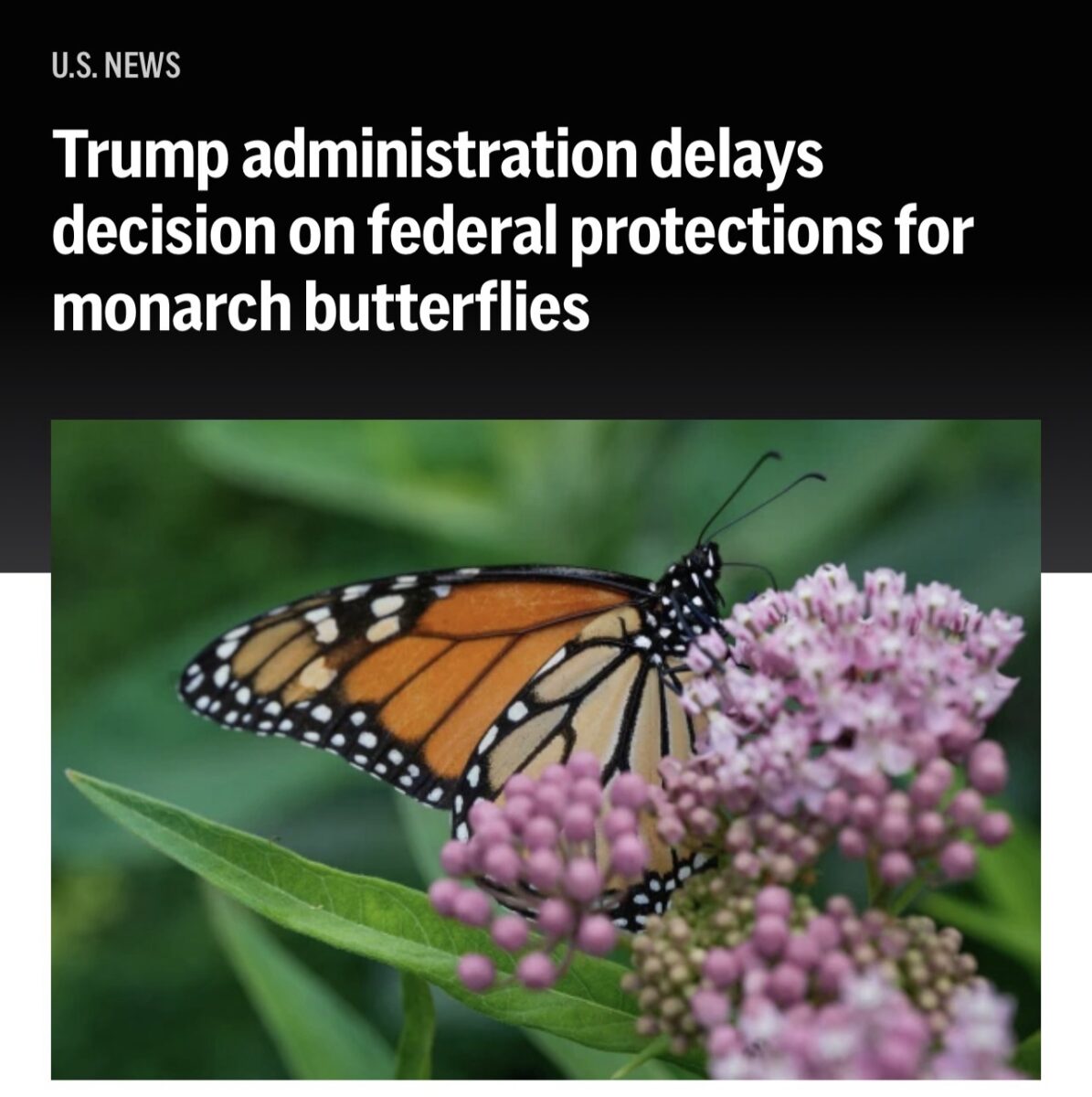
Monarch Butterfly Protection Delayed: Why This Is Very Bad News
In December 2024, the U.S. Fish and Wildlife Service (USFWS) announced a long-awaited proposed rule to list the monarch butterfly as Threatened under the Endangered Species Act (ESA), including a special management provision known as a 4(d) rule. For conservationists, this was a hopeful step toward federal protection for one of North America’s most iconic — and imperiled — species.
But as of December 12, 2025, that hope has stalled.
The USFWS missed its legally required one-year deadline to finalize the monarch’s listing decision. Even more troubling, the monarch was left out of the federal government’s 2025 Unified Agenda, a planning document that outlines which regulatory actions agencies expect to complete in the coming year. Its absence means a final decision is now at least 9 months away, and possibly much longer.
To make matters worse, the monarch’s listing is now categorized as a “long-term action” — a designation used for rules not expected to result in regulatory action within the next 12 months. In practical terms, this means the monarch butterfly remains without federal protection, despite overwhelming scientific evidence of collapse.
Why the Proposed Listing Matters
The proposed rule (published December 10, 2024) would classify the monarch as Threatened, meaning it is “likely to become endangered in the foreseeable future.” While not as strong as an Endangered listing, a Threatened designation can still unlock meaningful protections — especially when paired with a well-designed 4(d) rule.
The proposed 4(d) rule recognizes the monarch’s most urgent needs:
More milkweed and nectar plants Protection and enhancement of overwintering habitat Reduced pesticide exposure Public participation and voluntary conservation
Rather than relying solely on prohibitions, the USFWS emphasized incentivizing conservation, encouraging landowners, communities, and organizations to take part in recovery efforts.
The Science Is Clear — and Alarming
The USFWS based its proposal on a comprehensive Species Status Assessment (SSA), which evaluates extinction risk using three criteria: resiliency, redundancy, and representation.
The findings are stark:
Eastern monarch population ▸ Declined ~90% ▸ 56–74% chance of extinction by 2080 Western monarch population ▸ Declined over 99% since the 1990s ▸ More than 99% chance of extinction by 2080
These numbers are not projections of inconvenience — they are forecasts of disappearance.
Critical Habitat: What It Does (and Doesn’t) Do
The proposed rule includes designation of critical habitat, focused primarily on California’s western overwintering sites.
Importantly:
Critical habitat only affects federal actions Private landowners are not impacted unless federal funding or permits are involved The goal is to ensure federal projects do not further destroy essential overwintering groves
Despite confusion and fear-based narratives, this designation is not a blanket restriction on private property.
Concerns for Education & Research
Some conservation and education organizations have raised concerns about proposed limits on handling monarchs — particularly a 250-butterfly annual cap for scientific or educational activities without a permit.
Programs like community science tagging, classroom education, and research often exceed this threshold. While USFWS has stated that permits could allow these activities to continue, many advocates argue that:
Key educational and research efforts should be explicitly exempt, or The cap should be raised to reflect real-world conservation work
What Has Changed Right Now?
Nothing — and that’s the problem.
Because the listing has not been finalized:
No new protections are in place Habitat loss continues unchecked Overwintering sites remain vulnerable Pesticide exposure continues Climate stressors intensify
A public comment period closed May 19, 2025, and more than 68,000 comments were submitted. Yet the monarch remains in regulatory limbo.
Why the Delay Is So Dangerous
We are losing monarch habitat faster than we are restoring it.
Even with tens of thousands of certified gardens and hundreds of thousands of milkweed plants distributed, conservationists estimate we need:
Millions of new milkweed plants annually Mass participation, not niche action Stronger federal leadership, not indefinite delays
Every year without protection pushes the monarch closer to a point of no return.
What You Can Still Do
Even without federal action, monarchs still need us:
Plant native milkweed appropriate to your region Protect and speak up for overwintering groves Support conservation organizations doing on-the-ground work Educate others — awareness drives action Stay engaged and informed
The Bottom Line
The science is clear.
The decline is undeniable.
The delay is dangerous.
The monarch butterfly was on the brink — and federal protection was supposed to be a turning point. Instead, uncertainty now threatens to become inaction.
The monarch cannot afford to wait.